
Under-Slab Plumbing and Slab Leak Tunneling in Green Valley
Green Valley Homes and the Pipes Beneath Them
Green Valley opened in the late 1970s as one of the first master-planned communities in Southern Nevada, and building rolled outward through the 1980s and 1990s. That long timeline means two houses on one block off Green Valley Parkway can hide very different plumbing.
Copper supply lines after decades of hard water
Many early Green Valley homes were plumbed with copper running through or beneath the concrete. Years of mineral-heavy valley water, plus soil that shifts slightly with the seasons, are often blamed when a pinhole finally opens. A warm patch of tile or a meter that keeps turning with every faucet off are the usual first clues.
Drains from the same era
Original drains here are frequently older ABS, and a few of the earliest builds may carry cast iron sections. We put a camera down the line first, because one sagging joint calls for a different fix than a pipe failing from end to end.
Reaching a Leak Without Lifting Your Floors
Plenty of owners here have spent years upgrading kitchens and baths, so breaking new tile to chase a leak feels like starting over.
How a side-yard tunnel works
We dig beside the foundation, usually in a side yard or off the back patio, then tunnel sideways until we reach the damaged pipe. After the repair holds pressure, we refill the tunnel and compact it in lifts. Our page on locating and repairing water-line slab leaks walks through each step.
When we suggest something else
If a house has several leaks scattered across the slab, running fresh supply pipe through the walls and attic may beat chasing each one underground. We will tell you that plainly, even when it means less digging on our end.
Mature Lots, Block Walls and Neighborhood Rules
Lots near the Silver Springs Recreation Center and along the Pittman Wash trail tend to have established trees, block walls and irrigation that has been patched many times.
Roots and sprinkler lines
Thick roots and buried drip tubing are common in older yards, so we flag irrigation before the first shovel goes in and steer the tunnel away from large trees where we can. Plants we lift are set aside and replanted when the hole is closed.
A note for your HOA
Many Green Valley subdivisions have an association, and some want notice before exterior digging or equipment parked out front. Reading your CC&Rs early keeps a project from stalling. When the work needs a plumbing permit, we pull it through City of Henderson Building and Fire Safety.
Green Valley yards also tend to carry a history of their own: an old patio slab poured by a previous owner, a buried planter box, or a gas line run to a barbecue years ago. We call for utility marking and probe carefully before the tunnel gets deep.
Testing First, and the Streets Around Green Valley
Pinpoint before you dig
Most visits begin with acoustic leak detection and a sewer camera so the tunnel heads straight for the problem. If the trouble is a drain rather than a water line, replacing a worn ABS or cast iron branch may be the right path.
Nearby neighborhoods we cover
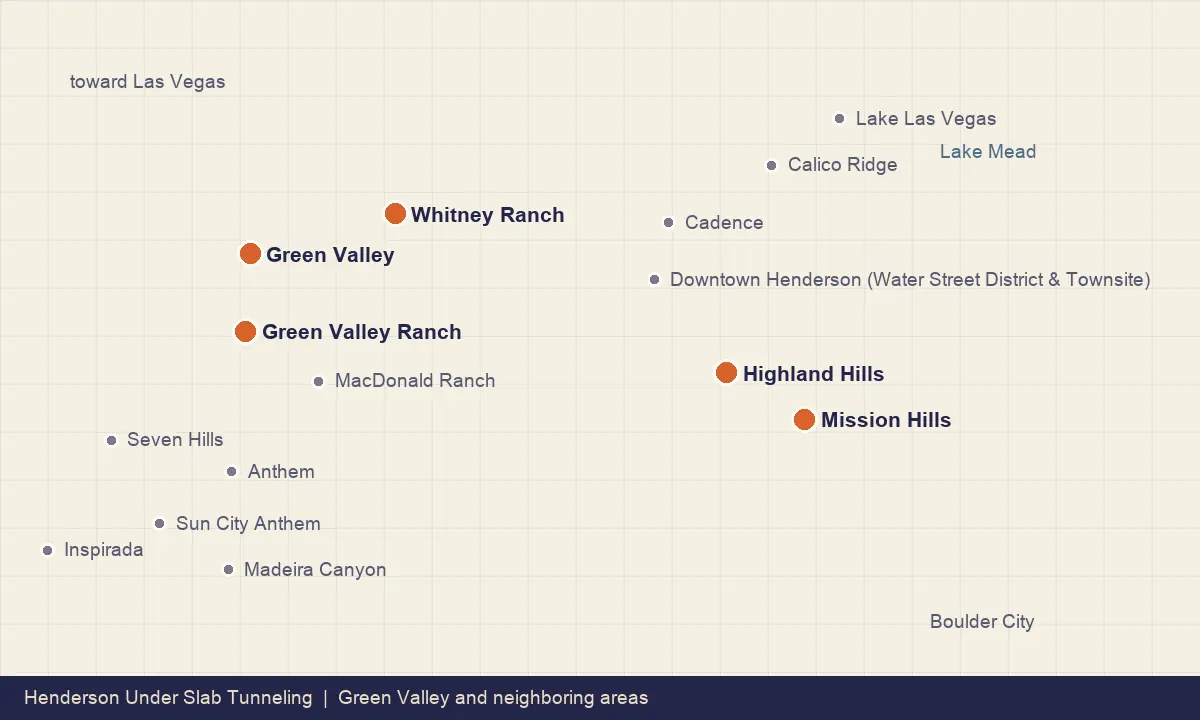
Our crews are just as often south in the 1990s streets of Green Valley Ranch, east toward Whitney Ranch near Galleria Drive, and out in the custom lots of Mission Hills and Highland Hills by the college campus. You can also browse the full list of Henderson communities we serve.
If testing shows the slab is fine and the leak is in a wall, we will point you in that direction and skip the excavation entirely.
Questions from Green Valley homeowners
Is my older Green Valley home likely to have copper under the slab?
Many homes from the late 1970s and 1980s were plumbed with copper, but builders varied and some houses were repiped by earlier owners. We confirm what you actually have with a pressure test and leak location before proposing a repair, so the plan fits the pipe in your slab rather than a guess based on the build year.
Will a tunnel hurt the big trees in my Green Valley backyard?
We plan the tunnel path around large trees whenever the pipe location allows, and we would rather start the dig in a side yard than cut through a major root zone. If a tree sits directly over the only practical route, we explain the tradeoffs and alternatives, such as rerouting, before anything is dug.