
Camera Inspection and Leak Detection in Henderson
Why Every Under-Slab Job Starts Here
Under-slab plumbing is hidden by design. Without good diagnostics, a repair turns into guesswork, and guesswork under a foundation means extra digging, extra time and extra disruption. Diagnostics are how we keep tunnels short and recommendations honest.
Answers you can see
Camera footage and test results give you something concrete to look at. You can see the crack, the belly or the pressure drop yourself, instead of relying on someone's description. That evidence is also useful if you want a second opinion or if your insurer asks for documentation.
Sometimes the answer is good news
Not every symptom points to a slab problem. A running toilet, a leaking irrigation valve or a clog near a fixture can mimic under-slab trouble. A proper inspection can rule out the slab entirely, which may save you from a repair you did not need.
We would much rather spend an hour confirming a problem than spend days digging toward the wrong one. That habit protects your yard, your floors and your budget.
How an Inspection Visit Works
The exact tests depend on whether we are looking at a water line, a drain or both.
- Hear the history. We ask about symptoms, water bills, past repairs and the age of the home.
- Rule out the simple causes. We check fixtures, the water heater, irrigation and the meter to make sure the problem is really below the floor.
- Test or camera the lines. Water lines get isolated pressure tests; drains get a sewer camera run from a cleanout or fixture.
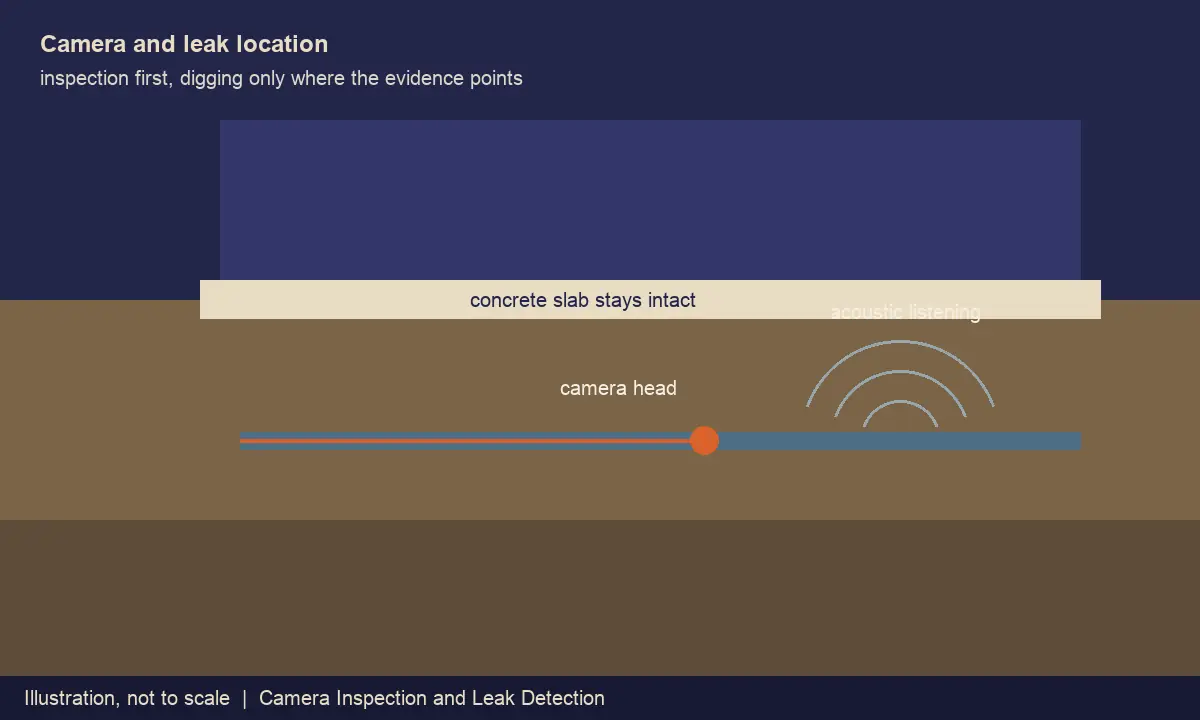
- Pinpoint and mark. Acoustic listening, thermal imaging and a camera locator narrow the location so we can mark it inside and out.
- Review the findings. We show you the footage and results and explain the repair options, including when none is needed.
Water line diagnostics
Pressure testing tells us which side is losing water, and listening and thermal tools help narrow down where.
Drain diagnostics
A camera shows cracks, separations, bellies, scale and root intrusion, and its locator shows where they sit under the slab. That position and depth become the starting point for planning any tunnel, so the entry point outside the house lines up with the actual failure.
What the Results Lead To
An inspection is only useful if it helps you make a decision. Here is how findings usually translate into next steps.
Water line findings
If testing confirms a leak in a pressurized line under the slab, the next question is whether to repair that one spot or reroute the line. Our page on fixing a water line leak below the floor explains how we weigh that choice using the test results and the age of the pipe.
Drain line findings
If the camera shows a cracked, separated or bellied main drain, the footage tells us how much of the line is affected. A long failure under living space is often best handled by tunneling to replace the building drain. A single failed branch is usually a smaller, targeted repair. In other cases, the camera shows a line that is sound and just needs cleaning, and we will tell you that too.
Either way, you leave the visit with a clear explanation of what is happening below your floor and a set of options you can compare, rather than a single answer and a request to trust it.
When Diagnostics Alone Are Not the Right Fix
Diagnostics are powerful, but they have limits, and we think homeowners deserve to know them.
When results point in more than one direction
Leak location narrows the area, but it is not a perfect map. Caliche, deep lines, multiple leaks or a lot of background noise can make a precise location harder. In those cases we may recommend additional testing, or a small exploratory opening, rather than guessing at a long tunnel.
When a camera cannot get through
A camera needs a way into the line, such as a cleanout or a removed fixture. Heavy scale, a collapse or standing water in a belly can block the view past a certain point. When that happens, we explain what we could and could not see, and what it would take to get a complete picture before any repair is planned.
An inspection also does not fix anything on its own. Once the problem is confirmed, the repair still has to be planned, permitted where required, and carried out. We treat the diagnostic visit as the first step, not the last.
Inspections Across Henderson
We run inspections all over the city, from the oldest neighborhoods to newer homes with questions about builder work.
Hillside and active adult communities
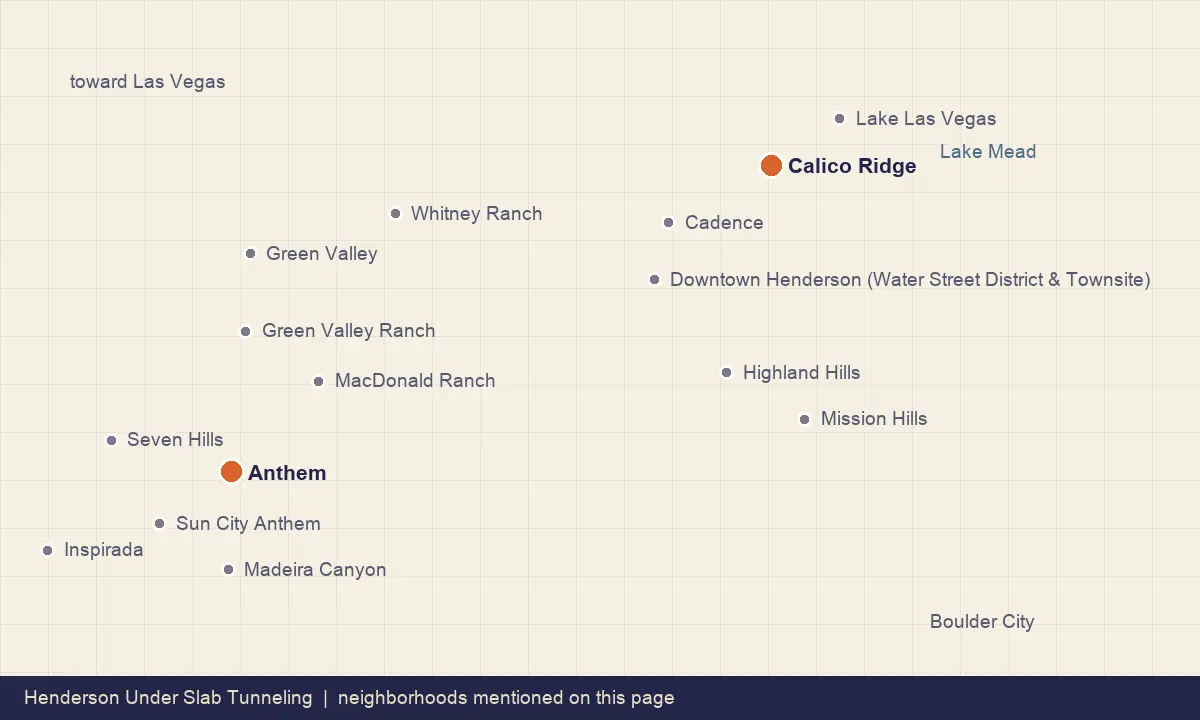
In Anthem homes on the hillside, owners often call when a water bill jumps or a drain slows, and testing helps sort out whether the slab is involved. Homes near Calico Ridge in east Henderson span several building eras, so inspections there often start with figuring out what kind of pipe is under the floor.
Before you schedule a repair
If someone has already recommended a big repair, an independent inspection is a reasonable step, and the footage gives you something solid to compare against. More answers are on our leak detection and inspection FAQ, and you can book a camera or leak detection visit from our contact page.
Camera Inspection and Leak Detection questions
Do I really need an inspection before a slab repair?
We strongly recommend it. Without testing, there is no reliable way to know which line is failing, where the failure is, or how much of the pipe is affected. That information determines whether a short tunnel, a longer tunnel, a reroute or a simple fix above the slab is the right answer. An inspection can also rule out the slab entirely when the problem is somewhere else.
How accurate is leak detection under a slab?
Pressure testing reliably shows whether a line is leaking. Pinpointing the exact spot is less certain. Acoustic and thermal tools can usually narrow the location to a workable area, but soil conditions, depth, background noise and multiple leaks all affect accuracy. We tell you how confident we are in a location and plan the repair with that in mind, rather than overstating precision.
Can I watch the sewer camera footage?
Yes. We encourage it. Seeing the inside of the line yourself is the best way to understand what we are recommending and why. We can show you the footage during the visit and point out cracks, separations, bellies, scale or roots as they appear. Having that record is also helpful if you want a second opinion or need documentation for an insurance claim.
What if the inspection shows nothing wrong under the slab?
Then we tell you so, and we point you toward where the problem is more likely to be. Plenty of symptoms that look like a slab issue, such as a high water bill or a slow drain, turn out to come from fixtures, irrigation or a clog that simple cleaning can clear. Ruling out the slab is a useful result in its own right.